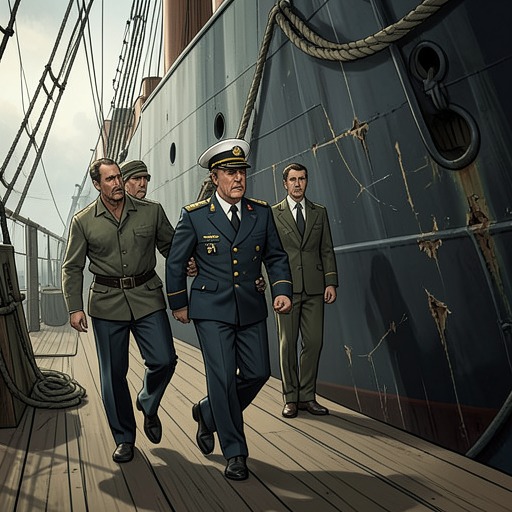
December 18, 1944
The Caine MutinyDecember 18, 1944 is the date attached to Steve Maryk’s removal of Philip Francis Queeg from command of the USS Caine, the act that becomes the central legal and moral crisis of the novel. Its importance lies both in the shipboard decision it dates and in the way the Navy’s later charge turns that decision into a precise question of authority and justification.
Date and Charge
The formal specification says that Maryk acted on or about December 18, 1944, aboard the USS Caine, relieving Queeg, its duly assigned commanding officer, while the United States was at war. The wording makes the date an anchor for the accusation, while “on or about” leaves the charge itself slightly approximate. The act is not presented merely as a dispute between officers: the specification frames it as a potentially unauthorized removal of a lawful commander, and makes the circumstances and justification for that removal decisive.
The date therefore gathers together two competing accounts of the same crisis. In the prosecution’s formulation, Maryk willfully took command away from Queeg without proper authority or justifiable cause. The defense must address not simply whether the removal occurred, but whether the circumstances made it necessary. December 18 becomes the point around which the novel’s conflict over obedience, command responsibility, and the limits of a subordinate’s authority is examined.
A Date Within the War’s Longer Rhythm
The novel sets this crisis against a war whose strategic contours and the sailors’ daily experience scarcely seem to match. Its account of the beginning of 1944 describes the Allied position as increasingly favorable, while Willie Keith, standing midnight watch on New Year’s Eve, sees instead the prospect of dangerous Pacific operations. In January, a vast formation of ships leaves Hawaii for Kwajalein. The large-scale movement of the fleet is carried out by officers who maintain its precise formation, even though many are not professional seamen.
The USS Caine’s own time is less dramatic and more repetitive. Willie’s early life aboard includes sleeping in a cramped clipping shack, while watches, coding, publication corrections, and interrupted rest narrow his days to recurring duties. Under Queeg’s new order, a cigarette butt in a scupper prompts the cancellation of the crew’s liberty; compliance then concentrates in the small area Queeg can see and hear, leaving the rest of the ship to its older habits. Later, months of escort work under the Seventh Fleet dissolve into watches, reports, audits, and repeated voyages. At Funafuti Atoll, the destroyer tender’s communications office offers Willie relief from the burden of decoding fleet messages. These details make the dated command crisis part of a much longer account of military time: operational schedules, routine labor, and discipline shape life aboard even when no major battle is in view.
Historical and Narrative Status
December 18, 1944 is a date within a work of historical fiction, not evidence that the described case occurred in the actual Navy. The novel’s prefatory note states that the people and events aboard the Caine are imaginary, that no ship named USS Caine existed, and that the records it cites contain no instance of a court-martial resulting from a captain’s relief at sea under Articles 184, 185, and 186 of the Naval Regulations. It also explains that operational details were altered to serve the story or avoid reproducing potentially classified information.
That disclaimer sharpens the date’s function rather than diminishing it. The precise wartime setting gives the fictional dispute the structure of a historical and legal record, while the note distinguishes that constructed case from actual naval history. The date thus marks the novel’s decisive conflict and the boundary between its documentary appearance and its invented events.